Glass shop doors: safety glass and the markings they need
Do glass shop doors need safety glass and visible markings? How AS 1288 and AS 1428.1 fit together, what to ask for, and why a logo is not always a marking.
By Glassy Slide teamPublished 3 min read
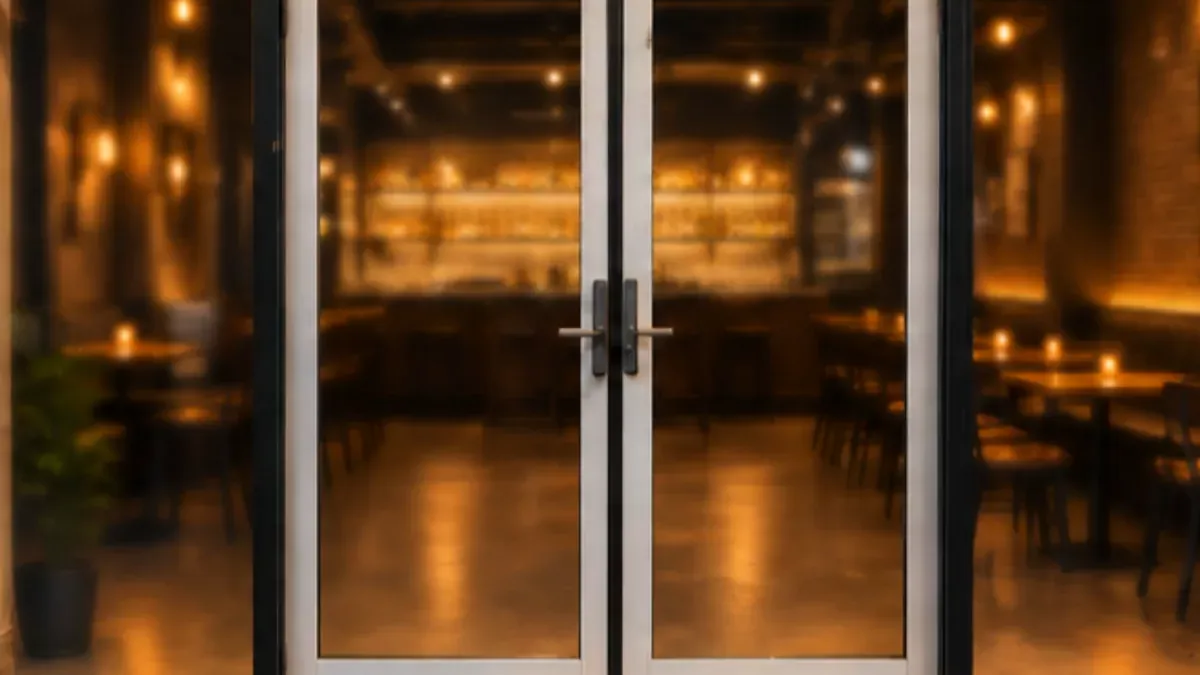
Glass doors are the part of a shopfront people lean on, push through and walk toward. Two things apply to them: the glass has to be the right kind, and people have to be able to see it. Here is how the rules fit together, in plain words.
Safety glass in and beside doors
NCC Volume One, which covers shops, calls up AS 1288-2021 Glass in buildings: Selection and installation (Standards Australia). Its human-impact section deals with glass in doors, glass in side panels beside doors and low-level glass, which generally has to be safety glass, toughened or laminated (AGWA).
Safety glass is selected for each opening, and AS 1288 is one requirement among others. A glazier looks at the position, the size of the pane, the frame and the likelihood of impact. We don't quote distances or heights here, because they depend on the edition of the standard and on the opening. See our guide to replacing broken shop glass.
Making glass visible
A large clear door with clear glass beside it can look like an open doorway. Glass that could be mistaken for an opening needs to be made visible. This is often called manifestation.
Two sets of rules overlap, and that is where most of the confusion online comes from:
- AS 1288 deals with the glass itself and with making it apparent.
- AS 1428.1 applies where the building code requires access for people with a disability, which includes a shop's accessible entrance. It sets out visual indicators on glass doors and the glass beside them. The Australian Human Rights Commission's view is that the indicator should be solid and continuous, because broken lines, symbols or words may not do the job (Australian Human Rights Commission, reproduced by Sydney Access Consultants).
The measurements are set in the standards, and they have changed between editions. We don't quote them here. Ask for the figures for your door and have your design checked before it is applied.
A logo is not always a marking
Shop owners often want frosting or a logo across the door, and it can double as visibility in some designs. But access consultants read the 2021 edition of AS 1428.1 as asking for a solid, unbroken strip, with logos only above or below it (Realm Access). A pattern that breaks up or covers the strip may not do what the door needs. If you are planning frosting or graphics, read frosting, logos and privacy film on shop glass as well.
Marking never replaces safety glass where safety glass is required, and safety glass doesn't remove the need to make the glass visible.
The whole door matters
A certificate for the glass alone does not show that a whole door or window assembly complies (QBCC). The frame, fixings and fittings count too. If you have a frameless door, the patch fittings and pivots matter as well; see frameless or aluminium-framed shopfronts.
When an old pane is replaced
If the old pane was ordinary glass and the opening needs safety glass, the replacement may be an upgrade, and that changes the price. We tell you what each pane needs when we measure, and we put the glass type for each pane in the quote. Our shopfront cost guide sets out what moves the price.
Talk to us about your shop doors
We supply and fit aluminium-framed and frameless shopfronts and entry doors across Melbourne, repair shop doors, closers, pivots, patch fittings and locks, and make broken glass safe 24/7 on 0410 107 794. See shopfronts and entry doors, safety glass replacement or ask for a shopfront quote.
Questions
Do glass shop doors have to be safety glass?
In general, yes. The glass in and beside doors, and low-level glass, is where people are most likely to be hurt, so it is assessed under AS 1288, which the National Construction Code calls up. Toughened or laminated safety glass is the usual result. The glass is selected for each opening, so a glazier looks at the actual door and the glass around it.
Do glass doors need markings?
Glass that could be mistaken for an open doorway needs to be made visible. Where a shop entrance must be accessible, AS 1428.1 also sets out how visual indicators on glass doors and side glass work. The exact heights and sizes depend on the edition of the standard and the opening, so ask for them for your door.
Can I use my logo or frosting as the marking?
Not automatically. Access consultants read the 2021 edition of AS 1428.1 as asking for a solid, continuous strip, with logos above or below it rather than in place of it. Check your design against the standard before it is applied.
Is a certificate for the glass enough?
Not on its own. A certificate for the glass does not show that the whole door or window assembly complies, so the frame, fixings and fittings matter as well.
Does replacing an old pane mean upgrading it to safety glass?
Often it can. If the old pane was ordinary glass and the opening needs safety glass, the replacement may be an upgrade, which changes the price. We tell you what each pane needs when we measure.
Do you apply the markings?
We supply and fit the door glass and doors, and we tell you which panes need safety glass. The strip or decals are usually applied by a signwriter or film supplier once the design is checked against the standard.
Was this guide helpful?

We supply and install double-glazed aluminium windows and doors, alfresco enclosures and glass partitions, and repair timber windows across Melbourne from our base in Bundoora. 5.0 ★ on Google.
Keep reading
Related guides
Shopfronts3 min read
Automatic sliding doors for a small shop: cost, rules and retrofitting
What an automatic sliding door for a small Melbourne shop involves: market costs, fitting into an existing front, exit and standards questions, and servicing.
Shopfronts3 min read
Frosting, logos and privacy film on shop glass: what to know first
Frosted film, printed logos and privacy film on shop windows and doors in Melbourne: the options, what to check with the glass, your lease and council first.
Shopfronts3 min read
Frameless glass or aluminium-framed shopfront: which suits your shop?
Frameless glass or an aluminium-framed shopfront? How they compare for look, doors, security, repairs and cost, and which suits a Melbourne shop.