
Frameless glass or aluminium-framed shopfront: which suits your shop?
Frameless glass or an aluminium-framed shopfront? How they compare for look, doors, security, repairs and cost, and which suits a Melbourne shop.
By Glassy Slide teamPublished 3 min read
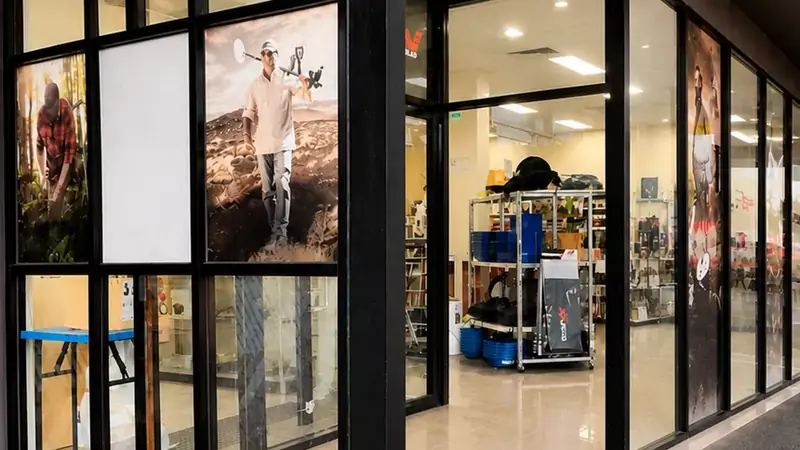
Most shop owners have an idea of the look they want: clean and open, or traditional and solid. In glass, that usually comes down to two systems. Here's how an aluminium-framed shopfront compares with a frameless one, and which tends to suit which shop.
The two systems in plain words
Aluminium-framed. Glass panels are held in aluminium frames, usually powder-coated in a colour that suits the building. Doors are framed too, with closers, pivots and locks fixed to the frame.
Frameless. Large panes of toughened glass are fixed with fittings at the corners and edges rather than in a continuous frame. Doors are typically glass with patch fittings and pivot hinges, so there is very little visible metal (Maison Glass & Aluminium).
Explore the shopfront in 3D
Drag to rotate · click the door
Scroll or pinch to zoom. With the model focused, use arrow keys to rotate, Enter or Space to open or close the door, Home to reset, and plus or minus to zoom. Play repeats the door movement until paused. Without 3D, the static drawing and description remain available.
How they compare
| Consideration | Aluminium-framed | Frameless |
|---|---|---|
| Look | Visible frames in a colour of your choice; a more traditional or defined front | Open and minimal; the display and the shop interior are the focus |
| Glass | Safety glass selected for each opening; double glazing is possible in suitable frames | Thick toughened glass, with safety requirements assessed for each opening |
| Doors and hardware | Framed swing, pair or sliding doors; closers, pivots and locks fixed to the frame | Glass doors with patch fittings, pivots and locks; needs precise fitting |
| Security | Depends on the glass, the frame, the fixings and the lock | Depends on the glass, the fittings, the door and the lock; laminated glass can help |
| Repairs | A pane can often be reglazed in its frame; hardware is repairable | A broken toughened panel is replaced; fittings are repaired or replaced |
| Cost | Usually the more economical choice | Usually costs more |
| Permits and lease | Like-for-like replacement is often exempt from a building permit; heritage areas and leases may limit changes | The same applies; check the surveyor, council and your lease |
Which suits which shop
- A shop that wants the display to do the selling. Frameless glass gives the clearest view in and the lightest look. It suits fashion, jewellery, galleries and showrooms, if the budget allows.
- A busy shop that needs easy repairs. A framed front and framed doors are easier to repair in small steps: a closer, a lock, a seal or one pane at a time.
- A heritage or character street. Councils' heritage guidelines usually favour keeping the traditional shopfront parts, so a framed front often fits better. Check with your council first (shopfront permits in Victoria).
- A shop that wants security and weather sealing. Either system can be specified for it. What decides the outcome is the whole assembly, not the label (shopfront security).
Safety glass and visibility
Doors, sidelights and low-level glass need safety glass selected for the particular opening, including AS 1288. Large clear panels also need to be made visible so people don't walk into them, which is why you see strips or frosting at eye height. A glazier assesses each opening before specifying the glass. We don't give dimensions here because they depend on the opening and the building.
What it costs
Frameless usually costs more than aluminium-framed. Thicker toughened glass, precise fittings and careful installation all add to the bill. The size, the doors, the access and any permit decide the rest. Our shopfront cost guide lists published market figures and what moves the price, and every shopfront is measured and priced in writing.
Repair or replace
Your current shopfront may not need replacing at all. Closers, pivots, patch fittings and locks on aluminium and frameless shop doors can often be repaired. If the front is worn out, see replacing an old shopfront.
Talk to us about your shopfront
We supply and fit aluminium-framed and frameless shopfronts and entry doors across Melbourne, repair shop doors and locks, and make broken fronts safe 24/7 on 0410 107 794. See shopfronts and entry doors, safety glass replacement or ask for a shopfront quote.
Questions
Do you supply and fit both frameless and aluminium-framed shopfronts?
Yes. We supply and fit aluminium-framed and frameless shopfronts across Melbourne. We measure on site and quote in writing, with the glass, the frame or fittings and the doors listed.
What is the difference between a frameless and an aluminium-framed shopfront?
An aluminium-framed shopfront holds its glass in aluminium frames, with doors in frames too. A frameless shopfront uses large toughened glass panels, usually with fittings at the corners and edges instead of a continuous frame, so there is little visible metal.
Is a frameless shopfront more expensive?
Usually, yes. Frameless glass needs thicker toughened glass and more precise fittings. How much more depends on the size, the doors and the access, so every shopfront is measured and quoted in writing.
Is frameless glass less secure?
Not automatically. Security depends on the whole assembly, meaning the glass, the fittings, the door and the lock. Laminated glass and well-fixed fittings help, and no shopfront is a guarantee. A frame and fixings strong enough to hold the glass matter either way.
Which is easier to repair?
A framed shopfront can often have one pane reglazed in its frame, and its closers, pivots and locks are repairable. Frameless glass is usually toughened, so a broken panel is replaced rather than repaired, and the fittings are repaired or replaced as needed.
Do frameless glass doors need markings?
Glass that can be mistaken for an opening needs to be made visible, and the safety glass in and beside doors is selected for each opening under AS 1288. A glazier assesses the doors before specifying anything.
Was this guide helpful?

We supply and install double-glazed aluminium windows and doors, alfresco enclosures and glass partitions, and repair timber windows across Melbourne from our base in Bundoora. 5.0 ★ on Google.
Keep reading
Related guides
Shopfronts3 min read
Shop theft and break-ins: how glass gets broken and how to make it harder
How thieves get through shop glass, doors and locks, which upgrades make a break-in harder, and what to do straight after theft or a smashed window in Melbourne.
Shopfronts3 min read
Do I need a permit to change my shopfront in Victoria?
When a Melbourne shopfront change needs a building permit, a planning permit or heritage approval, what is usually exempt, and who decides.
Shopfronts3 min read
Replacing an old shopfront: modern aluminium doors, sliding doors and security glass
When an old Melbourne shopfront is worth replacing, what a modern aluminium door system, sliding or automatic doors and security glass involve, and how the job runs.