
Automatic door servicing in Victoria: AS 5007, safety checks and ESM
Who checks an automatic door, what a service covers, whether it counts as an essential safety measure, and what to ask a servicing company in Victoria.
By Glassy Slide teamPublished 5 min read
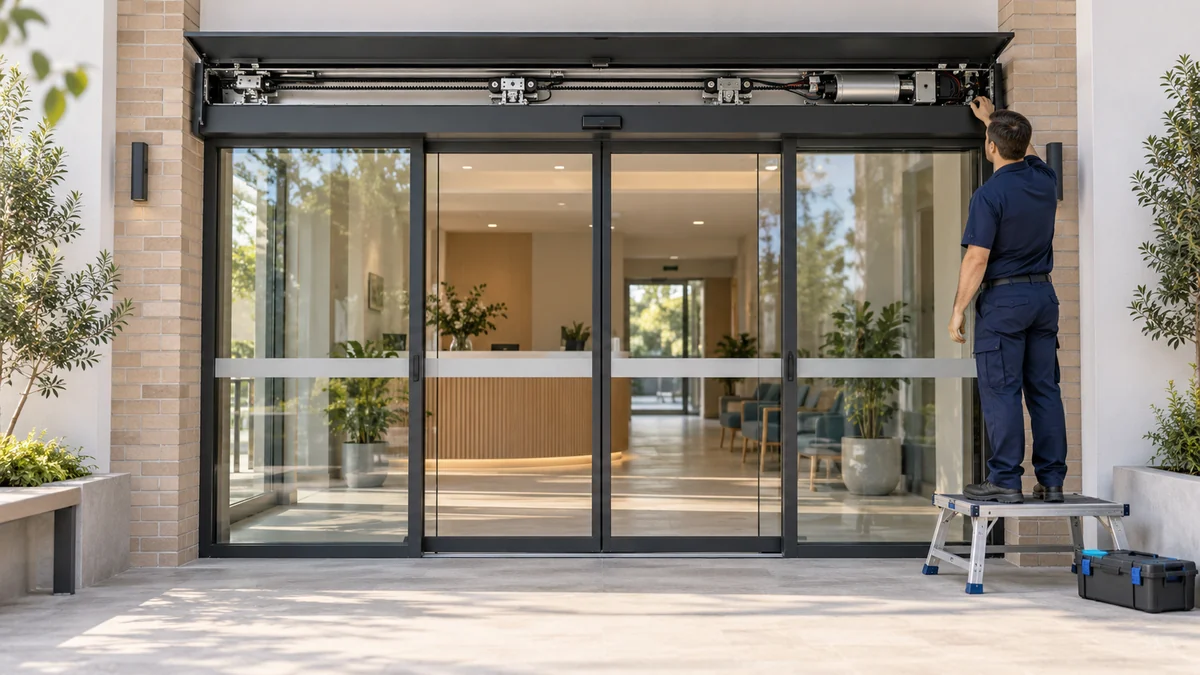
An automatic door is used all day, so it wears. If it is also part of your building's fire and exit safety, somebody has to check it, record the check and keep the paperwork. This guide explains who does what in Victoria, what a service involves and what to ask before you hire anyone. It adds to our guide on automatic sliding doors for a small shop, which covers cost and fitting.
Two different questions
People mix these up, so keep them apart:
- Is the door working safely? That is about sensors, safety devices, speed, timing and mechanical wear. AS 5007 is the standard for powered pedestrian doors.
- Is the door an essential safety measure (ESM) in your building? That is a Victorian building-regulation question about exits and paths of travel. It decides who must maintain the door, how often and what records exist.
A door can be a working, well-kept automatic door and still not be an ESM. It can also be an ESM that has not been checked for a year. They are separate.
Is your automatic door an essential safety measure?
The Building and Plumbing Commission (BPC) describes ESMs as safety systems in buildings other than houses and outbuildings, such as fire detection and alarm systems, sprinklers and emergency lighting (BPC: essential safety measures). Its list includes exit doors and paths of travel to exits. It does not name automatic doors as a separate item.
A Victorian Small Business Commission list of ESMs includes "Doors (other than fire or smoke doors) in a required exit" and notes their self-closing, automatic closing and latching mechanisms (VSBC ESM list, March 2015). That is about closing and latching mechanisms on exit doors, which is not the same as saying every motorised sliding door is an ESM.
So the honest answer is: it depends. Two things decide it:
- Whether the door is part of a required exit or path of travel in your building.
- What your building's occupancy permit or maintenance determination says. The maintenance determination states each ESM, the performance required and the frequency of inspection, testing and maintenance (Building ESM 02, Building Practice Note, marked under review, February 2024).
Your building surveyor or owner's agent can tell you. If you lease the shop, ask your landlord or property manager for the building's maintenance determination.
Who is responsible
Under the BPC's guidance, building owners must maintain ESMs so that they operate satisfactorily, and occupiers must keep exits and paths of travel to exits accessible and clear of obstructions (BPC). The owner prepares an annual ESM report on the approved form, can authorise an agent, such as a maintenance contractor, to complete it, and must be able to produce maintenance records on request (BPC).
Who pays is a separate lease question. The Victorian Small Business Commission explains that, from 23 September 2020, a retail landlord can recover certain ESM repair, maintenance and fit-out installation costs as outgoings where the lease and the required disclosure statement or annual estimate of outgoings allow it. A tenant can also agree to carry out ESM repair and maintenance work. The building owner's safety obligations still need to be met. Check your lease and outgoings documents, and ask the VSBC or a lawyer before deciding who pays. See VSBC guidance. We cover another lease question in who pays for broken shop glass.
Checks the occupier can do
Follow the door supplier's written safety-check procedure and keep a record. For example, dormakaba's Australian service guidance recommends weekly checks, with daily checks for high-traffic entries involving children, older people or people with infirmity. This is manufacturer guidance, not a universal servicing interval for every door. Your door's instructions and any building-specific ESM schedule still apply. See dormakaba service guidance.
A sensible routine for any shop:
- Watch the door open and close. Note anything slow, jerky, noisy or late.
- Check presence detection and reopening only by the supplier's written test method. Do not use your body to test a closing door or improvise an obstruction test.
- Look at the track for grit, leaves and rubbish.
- Look for cracked or chipped glass, loose handles and damaged seals.
- Write down the date and what you saw. A simple log is worth having if anyone asks.
Keep operator covers closed and do not adjust sensors, controls or electrical parts. Leave those checks to the service technician. If the door moves unpredictably or does not respond safely, stop using it, keep people away from the moving panels and contact the technician. Keep required exits usable and follow the building's emergency arrangements.
What a service visit covers
Companies describe their visits differently, so ask for the checklist. In general a service looks at:
- Sensors and safety devices, and how the door reacts to them.
- Operator, drive and belt condition.
- Rollers, track and guides.
- Door speed, timing and hold-open settings.
- Locks and any manual or emergency operation.
- Glass, frames, seals and fixings.
- A written record of what was found and fixed.
How often is a fair question. The figure "at least three services a year" appears in the trade press, but it comes from a door supplier's article and the article does not quote the standard to support it (Australian Design Review). If the door is an ESM, the schedule in the maintenance determination sets the minimum. If it is not, agree a schedule with your service company based on how busy the entry is.
What to ask a servicing company
- Do you service doors you did not install, and what brands?
- What does a visit include? Can I see the checklist?
- Do you give a written report after each visit?
- How do your checks relate to AS 5007?
- What happens if the door fails out of hours?
- Is the quote a fixed price per visit, or per hour?
If the door is an ESM, also ask your landlord whether the building has a maintenance determination and who files the annual report.
Glass is part of the door
An automatic door is mostly glass moving beside glass. Cracked or chipped panels can fail without warning, and a damaged panel is a safety problem as well as a repair. Safety glass is selected for each opening, with AS 1288 as one of the requirements. If a panel breaks, make the area safe first; our broken shop window guide covers the first hour. If you are changing the door as well, read accessible shop entrances and shopfront permits in Victoria.
Talk to us about servicing
We service and repair automatic sliding doors, including doors we didn't install, for shops, clinics, offices and industrial sites across Melbourne. Send a short video of the door opening and closing on WhatsApp, with a photo of any label on it, and we will tell you what we need to see. We measure on site and quote in writing. See automatic sliding doors, shopfronts and entry doors or ask for a quote.
Questions
How often should an automatic door be serviced?
There is no single answer that applies to every door. A supplier may recommend several services a year, but that is a supplier recommendation, not wording we have read in AS 5007. If the door is an essential safety measure, the interval comes from the building's occupancy permit or maintenance determination. Ask your surveyor or your service company which one applies to you.
Is my automatic door an essential safety measure?
Not automatically. The Building and Plumbing Commission (BPC) lists exit doors and paths of travel to exits among essential safety measures, but does not list automatic doors as a separate item. Whether your door counts depends on whether it sits in a required exit or path of travel and on what your building's permit or maintenance determination says.
Who pays for servicing, the landlord or the tenant?
Check the lease and outgoings documents. Since 23 September 2020, Victorian retail landlords can recover certain ESM repair, maintenance and fit-out installation costs where the lease and the required disclosure or annual outgoings estimate allow it. Tenants can also agree to carry out ESM repairs and maintenance. This does not remove the building owner's safety obligations. Ask the VSBC or a lawyer about your lease.
What does AS 5007 cover?
AS 5007 is the Australian standard for powered doors for pedestrian access and egress. It sets out performance, safety and maintenance requirements, including safeguards against entrapment. Your servicing company should be able to say how its checks relate to it. The standard is paywalled, so we do not quote its details here.
What happens if the automatic door fails?
Sensors, power, locks and mechanical parts can all fail. If the door will not open or close safely, make the entry safe and call a servicing company. If glass is damaged, we make it safe first. Send us a short video of the door on WhatsApp.
Was this guide helpful?

We supply and install double-glazed aluminium windows and doors, alfresco enclosures and glass partitions, and repair timber windows across Melbourne from our base in Bundoora. 5.0 ★ on Google.
Keep reading
Related guides
Shopfronts4 min read
Accessible shop entrances: when a new door triggers an upgrade
When must a new shop door or shopfront be accessible? How the Premises Standards, the affected part and the tenant concession work, in plain English.
Shopfronts3 min read
Automatic sliding doors for a small shop: cost, rules and retrofitting
What an automatic sliding door for a small Melbourne shop involves: market costs, fitting into an existing front, exit and standards questions, and servicing.
Shopfronts3 min read
Glass shop doors: safety glass and the markings they need
Do glass shop doors need safety glass and visible markings? How AS 1288 and AS 1428.1 fit together, what to ask for, and why a logo is not always a marking.