
Shop automatic door has stopped working: what to check, and when to call
An automatic shop door that won't open, won't close or stops part-way: the safe checks to do first, what each symptom usually means, and when to call a technician.
By Glassy Slide teamPublished 5 min read
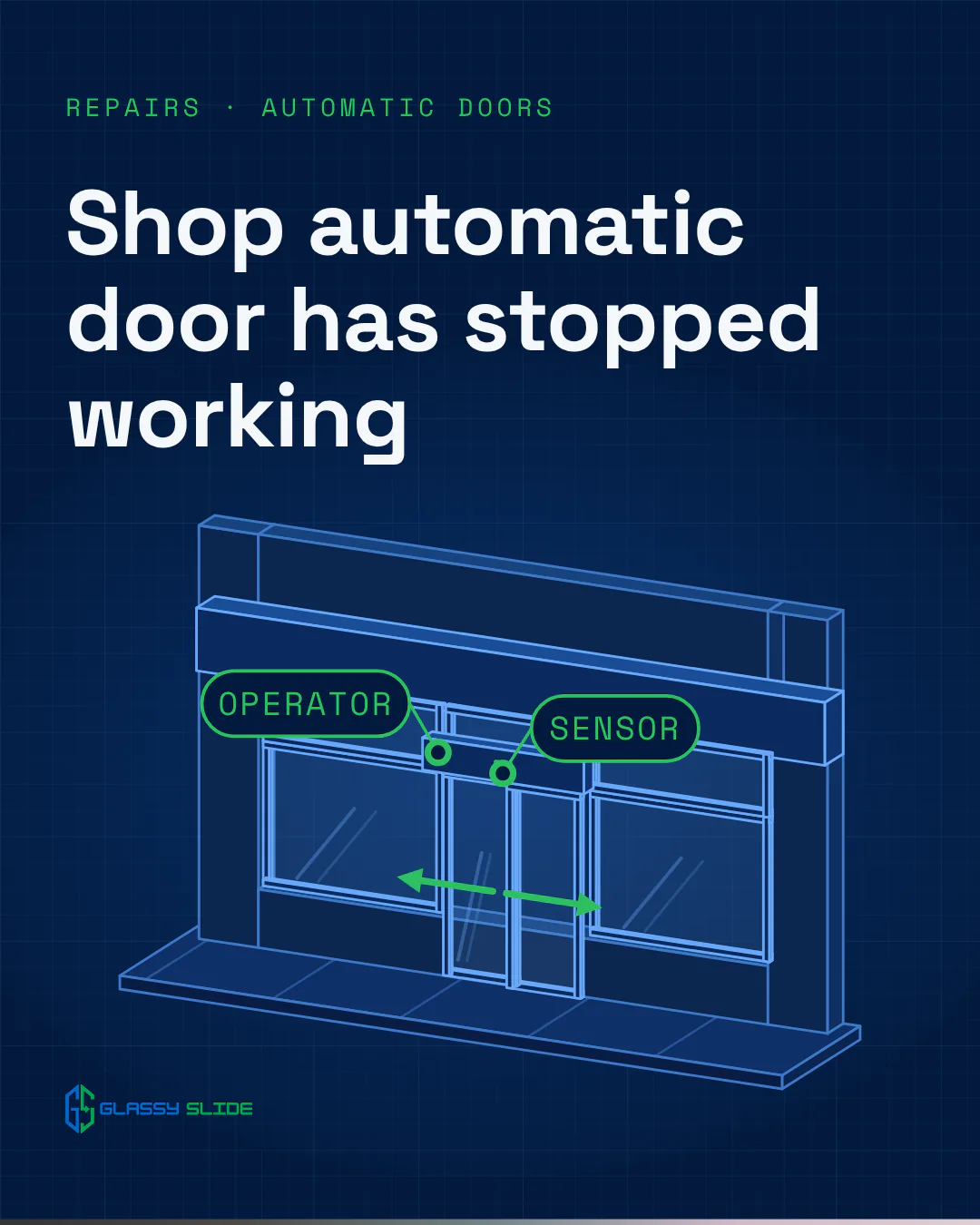
When an automatic door stops working, the shop loses its easiest entry, and a door stuck open or shut is a problem for the whole front. This guide is a fault-finding order for the first ten minutes: what to look at, what each symptom usually points to, and when to stop and call. It adds to our guides on automatic door servicing in Victoria, which covers who services the door, safety checks and essential safety measures, and automatic sliding doors for a small shop, which covers fitting and cost.
Make it safe first
- If someone is hurt or trapped, call 000.
- If any glass is cracked or broken, keep people away and make the opening safe. Our broken shop window guide covers the first hour.
- If a leaf is off its track, hits the frame or moves in a way you do not expect, stop using the door and keep people away from the moving panels.
- If the door is part of a way out of the building, keep that exit clear and usable. Whether it counts as one is a question for your building surveyor, and the servicing guide explains why.
How the door works, in one minute
Four parts matter for fault-finding. A sensor watches the zone in front of the door. A controller receives its signal. A motor in the head above the door turns a belt, and the belt pulls the leaves along a track on rollers. A fault in any of the four, or a door that has been set to the wrong mode, looks the same from the footpath: the door does not move.
Sensor, controller, belt and track: where a stopped door can fail.
Sensor and controller
- Sensor and controller. A sensor watches the zone in front of the door. When it sees someone, it signals the controller, and the controller tells the motor to open the door.
- Drive and track. The motor turns a belt in the head. The belt pulls the leaves along the track on rollers, and the wheels turn as the leaves move. Grit in the track or a worn roller can make the leaves slow, rough or stop.
- Where it goes wrong. If the sensor cannot see a person, for example because a sign covers it, the door stays shut. If something is in the track, the leaves start to open and stop short. Both look like a dead door, and a technician can tell them apart.
Simplified drawing, not an installation detail. Door travel and speed are exaggerated, parts differ between makes, and no sizes, settings or timings are shown. Each step lasts about 7 seconds when played.
Checks you can do safely
Suppliers describe the same basic checks. dormakaba's Australian service page recommends keeping the approaches clear of furnishings, advertising boards and other items, and looking over the leaves, glass, frames and door bases for damage (dormakaba Australia). US door companies add the first few items below (Stanley Access, Creative Door Services). Parts and controls differ between makes, so your supplier's instructions come first.
- Is it switched on and in automatic? Check the door's on and off switch, and any mode switch or key switch. A door left on a locked or hold-open setting will not behave as usual.
- Is anything in front of the sensor? Move displays, signs, plants and stock out of the zone. Signage near a sensor can stop it working properly, or make the door open and close on its own.
- Is the sensor window dirty? A dirty sensor can keep a door open when nobody is near it. Wipe the window gently with a soft, dry cloth, and do not open the cover or adjust anything.
- Is a push button stuck? A wall button held in the pressed position can keep the door open.
- Is anything in the floor track? Look for grit, leaves, a coin or a dropped item. Remove loose rubbish only when the door is not moving, and never force a leaf.
- Has anything changed recently? dormakaba lists recent refurbishment, other trades working near the door and changes to the entry layout among the reasons a door may need a service call. A new counter, a re-laid floor or a sign hung from the head is worth mentioning.
If the door has a labelled power switch, some suppliers suggest switching it off, waiting a short time and switching it on again. Follow your supplier's instruction for that. Do not reset, open or adjust anything else.
What each symptom usually means
These are common patterns, not a diagnosis. The same symptom can have more than one cause.
- Nothing happens, no lights, no sound. Power, the on and off switch or a tripped circuit, or the mode setting.
- The lights come on but the door does not open. The sensor may not be seeing people, or the controller or motor is not responding. If a check above fixes it, good. If not, call.
- It opens and closes by itself. Something in the sensor zone, a dirty sensor or a stuck push button.
- It stays open. The sensor can still see something, or a button is stuck.
- It stops part-way. An obstruction in the track, a worn or damaged roller or a bent track.
- It is slow, noisy, rubs or bangs. dormakaba lists slower movement, slower sensor response, rubbing, squeaking and banging among the signs that a technician should look at the door. Grit and worn rollers are common causes.
- A sensor indicator light that used to come on no longer does. Another sign to book a technician.
When to stop and call a technician
Call when:
- the checks above change nothing;
- the door stops part-way or hits something;
- a leaf has left its track or the glass is cracked or chipped;
- the door moves unpredictably, or does not respond safely to people in its path;
- the fault keeps coming back;
- you would have to open a cover or touch wiring to go further.
Do not tape over or disconnect a sensor, or jam the leaves with objects, to keep the door working. Those devices are there to protect people.
Stuck open or shut: the shop's security
A door stuck open overnight leaves the shop open, and a door stuck shut can leave a way in or out blocked. Tell the technician which it is when you call. If the shop must be secured straight away, ask how the door can be locked or held safely rather than forcing it, and use another entry if there is one. If glass is damaged, we do 24/7 make-safe and board-up for shops by phone.
What to send us
If you want us to look at it, send the following on WhatsApp on 0410 107 794:
- a short video of the door trying to open and close, taken from a safe distance;
- a photo of any label on the operator or sensor;
- a note of when it started, what the door does now and what changed before then;
- whether the door is a way out of the building.
We service and repair automatic sliding doors, including doors we didn't install, for shops, clinics, offices and industrial sites across Melbourne, and we will tell you what we need to see. See automatic sliding doors, shopfronts and entry doors or ask for a quote.
Questions
Why has my automatic shop door stopped opening?
Start with the simple causes. The door may be switched off or set to a locked mode, the power may be off, something may be covering or standing in front of the sensor, or the track may be blocked. If those checks change nothing, the sensor, controller, motor or rollers need a technician.
Why does my automatic door open and close by itself?
A sensor can pick up something it should ignore. A sign or display in its zone, a dirty sensor or a stuck push button are common reasons. Clear the area in front of the door and check the button. If it carries on, ask a technician to look at the sensor.
Why does my automatic door stop part-way?
Something in the track, a worn or damaged roller or a bent track can stop the leaves short. Check the floor track for grit and objects, but do not force the glass. If the track is clear and it still stops short, stop using the door and call a technician.
Can I wedge an automatic door open until it is fixed?
Do not jam the leaves with objects or tape over a sensor. Ask the technician how to hold the door safely, or use another entry. If the door is a way out of the building, keep that exit clear and usable.
Is a stopped automatic door an emergency?
If someone is hurt or trapped, call 000. If the glass is cracked or broken, keep people away and have it made safe. If the door is simply stuck shut or open, it is a service call, but a door stuck open overnight is also a shop security problem, so say so when you call.
What should I send you about a faulty automatic door?
A short video of the door trying to open or close, a photo of any label on the operator or sensor, and a note of when the fault started and what changed. Send them on WhatsApp. We will tell you what we need to see.
Was this guide helpful?

We supply and install double-glazed aluminium windows and doors, alfresco enclosures and glass partitions, and repair timber windows across Melbourne from our base in Bundoora. 5.0 ★ on Google.
Keep reading
Related guides
Shopfronts5 min read
Do shopfront windows need double glazing? Heat, noise and the NCC
Does a shop window have to be double glazed? What NCC 2025 says about shopfront glass, when double glazing helps with heat and noise, and what to ask for.

Shopfronts7 min read
Plate glass insurance for shops: is it worth it?
What shop glass cover usually includes, the questions to ask before you buy it, and how to decide if it is worth it for your shopfront in Victoria.
Shopfronts5 min read
Clinic, pharmacy and salon shopfronts: privacy with easy access
Shopfront glass for a clinic, pharmacy or salon in Melbourne: privacy where you need it, clear glass where you don't, and an entry everyone can use.