
Hot west-facing windows in a Melbourne summer: shade, toned glass and Low-E
Why west-facing rooms heat up on summer afternoons, what shade, toned glass and Low-E each do, and what to ask before you change the glass.
By Glassy Slide teamPublished 4 min read
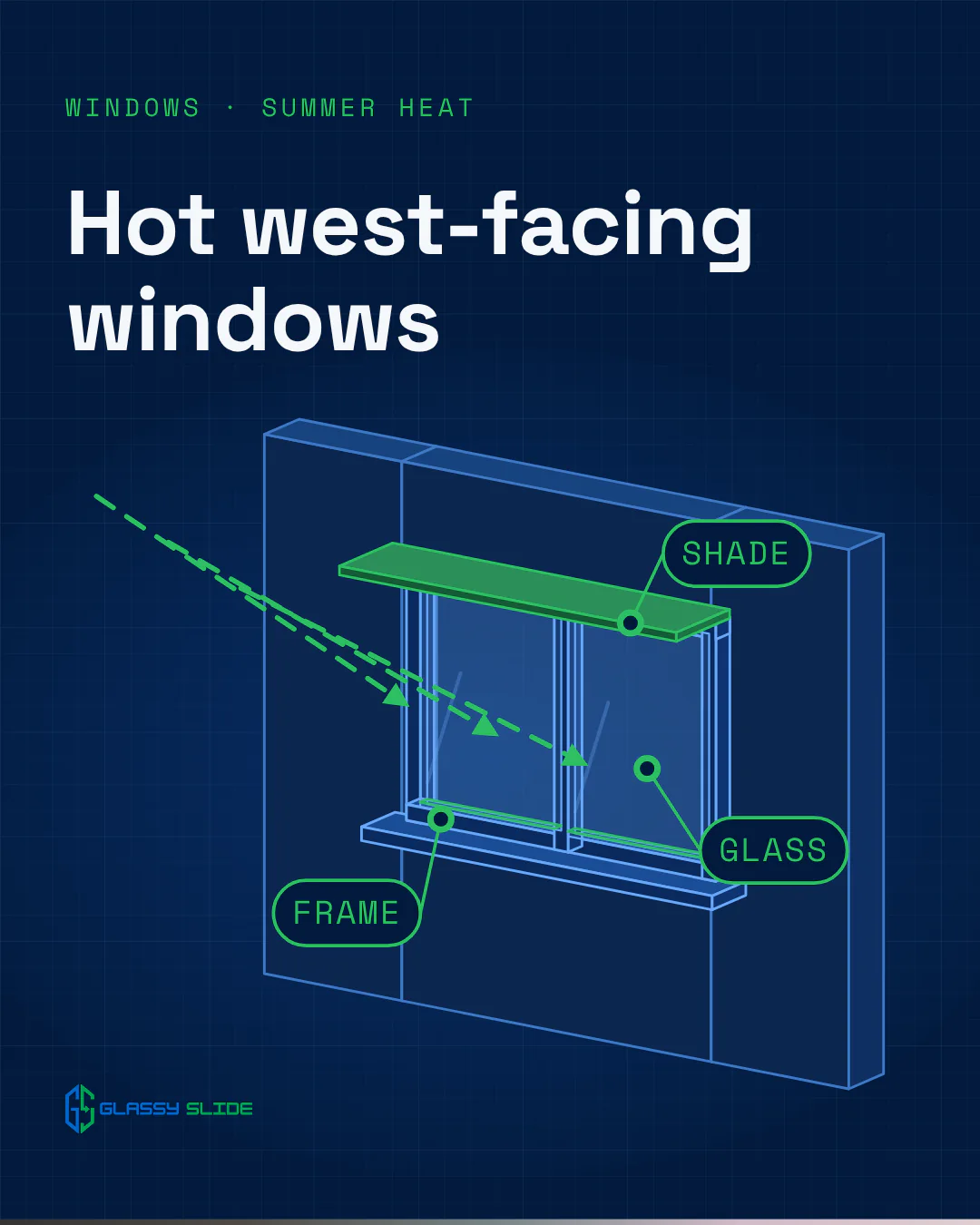
A west-facing living room can be pleasant all morning and hard to sit in by late afternoon. The glass is usually a big part of the reason, and there is more than one way to deal with it. This guide sets out what shade, toned glass and Low-E each do, and where the advice is less simple than a brochure makes it sound.
What this adds to our other guides
Our guide to quieter and warmer windows is mostly about noise and winter heat. Heat and condensation in a glass alfresco covers enclosed outdoor rooms. This one is about the summer afternoon problem in the rooms of the house.
Why the west is the hard side
In summer, west-facing windows take their sun in the afternoon, when the sun is lower in the sky and the house has already been warming all day. Sustainability Victoria describes west-facing windows as a major source of afternoon heat gain (reducing heat gain through home windows).
A low sun also gets under eaves and pergolas that work well on the north side. The same page says they are not very effective at shading east and west windows.
Shade first, if you can
Sun that never reaches the glass is the easiest heat to deal with. Sustainability Victoria says external shading is much more effective at keeping a home cool than internal blinds or curtains, and that using both gives the most protection. For west windows, adjustable shading that you can move through the day, such as an external blind, suits the low afternoon sun and can be lifted again in winter.
Shading is a separate job from the glass, and it is worth deciding about both together. If you are in a unit or townhouse, an outside blind or awning may need owners corporation approval.
What the glass can do
The figure to ask about is the solar heat gain coefficient, or SHGC. It runs from 0 to 1, and the lower it is, the less of the sun's heat comes through. YourHome, the Australian Government's home design guide, says east and west-facing windows should have a low SHGC, particularly if they are large, and that adjustable external shading is better where it is possible (YourHome: glazing). Ask for the figure for the whole window, frame included, not only the glass.
| Option | What it does | What to weigh up |
|---|---|---|
| Toned (tinted) glass | A tint made into the glass reduces the heat coming through | It can also reduce daylight, and winter sun as well as summer sun |
| Low-E glass | A thin coating that changes how heat moves through the glass | Products differ widely; check the SHGC, not just the words "Low-E" |
| Double glazing | Two panes with a sealed gap that slows heat moving through | On its own, clear double glazing still lets plenty of sun in |
| External shade | Stops sun before it reaches the glass | A separate job; may need approval |
The Low-E question
"Low-E" is often sold as the answer to a hot room. It is more careful than that.
- A Low-E coating is widely used to keep heat inside in winter. Sustainability Victoria says that adding one to the internal pane of glass helps make a house warmer in winter.
- The same Sustainability Victoria page says using Low-E glass to control heat gain is not recommended for Victorian conditions, because it also reduces the solar gain you want in winter (home window glazing).
- YourHome notes that Low-E coatings can change both how much heat passes through a window and its SHGC, so the effect depends on which coating it is.
The practical reading: do not choose a glass for a west window by its label. Say what the problem is, ask for the SHGC and the U-value (how fast heat passes through, lower is better) of the exact specification, and think about what the room needs in July as well as January. A room that gets welcome winter sun may call for a different answer from one that is hot most of the year.
Opening the window
Glass does not help much if the hot air cannot leave. When the evening cools, windows and doors that open on more than one side of the house let a breeze through. If you are replacing windows, the style changes how much of the frame opens: see aluminium window types. Insect screens let you leave them open.
Keep the frame or replace the window?
If a frame is sound and square, new glass or a double-glazed unit may fit into it. A unit is heavier and thicker than a single pane, so the frame, seals and hardware have to suit it: our checks for double glazing existing aluminium windows explain what we look at. For a large west-facing sliding door, see double-glazed sliding doors. Price ranges are in our double glazing cost guide.
Glass in doors and low windows has safety rules. It is selected per opening, with AS 1288 as one requirement, so the type is confirmed when we measure.
What to tell us
- Which rooms get hot, and at what time of day.
- Which way each window faces, and what shades it now.
- Whether the room is cold in winter as well.
- Photos of the windows from inside and outside, with rough sizes.
- Whether the property has a heritage overlay or owners corporation rules (see heritage overlay windows).
Ask us for a written quote
We supply double glazing, Low-E and toned glass, laminated and toughened glass and aluminium windows and doors across Melbourne. We look at which way the glass faces and what the room needs in both seasons, suggest what fits, and price it fairly, in writing, with the glass for each opening listed. See sliding doors and double glazing or ask for a double glazing quote.
Questions
Why are west-facing rooms so hot on summer afternoons?
The afternoon sun is low enough to reach straight into west-facing glass, at the end of a day that has already warmed the house. Sustainability Victoria notes that west-facing windows can be a major source of heat gain in the afternoon.
What is the best way to stop heat from a west-facing window?
Stop the sun before it reaches the glass where you can. Sustainability Victoria says external shading is much more effective at keeping a home cool than internal blinds or curtains. Glass choice helps too, especially where outside shade is not possible.
Is Low-E glass good for a hot west-facing window?
It depends on the Low-E product. Low-E is a family of coatings, and they do not all treat sun heat the same way. Sustainability Victoria advises that Low-E warms a house in winter and does not recommend it as the way to control heat gain in Victorian conditions. Ask for the solar heat gain coefficient of the exact glass or window quoted.
What is the solar heat gain coefficient (SHGC)?
A number from 0 to 1. The lower it is, the less of the sun's heat the window lets through. YourHome advises a low SHGC for east and west-facing windows, particularly large ones.
Does toned glass make the room darker?
It can. A tint reduces the heat coming through, and it can also reduce light, in winter as well as summer. Look at a sample against your own window before you decide.
Can you change the glass without replacing the window?
Sometimes, if the frame is sound and can carry the new glass or a double-glazed unit. We check the frame, seals and hardware on site first. If they are worn, a new window can make more sense.
Will new glass make the room cool on a heatwave day?
No glass choice does that on its own. Heat also comes through the roof, walls and air leaks, and from open windows at the wrong time of day. Glass and shade reduce one important source, and we do not promise a temperature.
Do I need approval to change west-facing windows?
It depends on the property. A heritage overlay, owners corporation rules or a bushfire area can all affect window work, and the council or a registered building surveyor decides what applies. Check before you order.
Was this guide helpful?

We supply and install double-glazed aluminium windows and doors, alfresco enclosures and glass partitions, and repair timber windows across Melbourne from our base in Bundoora. 5.0 ★ on Google.
Keep reading
Related guides
Cost guides4 min read
Double-glazed sliding doors in Melbourne: your options and what they cost
Retrofit double glazing or a new aluminium sliding door? The options for a Melbourne home, what each costs, and what a sliding door quote should list.
Double glazing5 min read
Aluminium window types: awning, casement, sliding, double-hung and fixed
How awning, casement, sliding, double-hung and fixed aluminium windows open, what each suits in a Melbourne home, and what to ask before you choose a style.
Cost guides4 min read
Window replacement cost in Melbourne: what aluminium double-glazed windows cost
What published Melbourne price guides say about replacing aluminium windows, why the figures differ so much, and how to compare quotes for a new double-glazed window.