
Shop glass cracked but not broken: repair, reglaze or replace?
A crack in a shop window or glass door that has not fallen out: what to check, why a crack can spread, and when it is made safe, reglazed or replaced.
By Glassy Slide teamPublished 6 min read
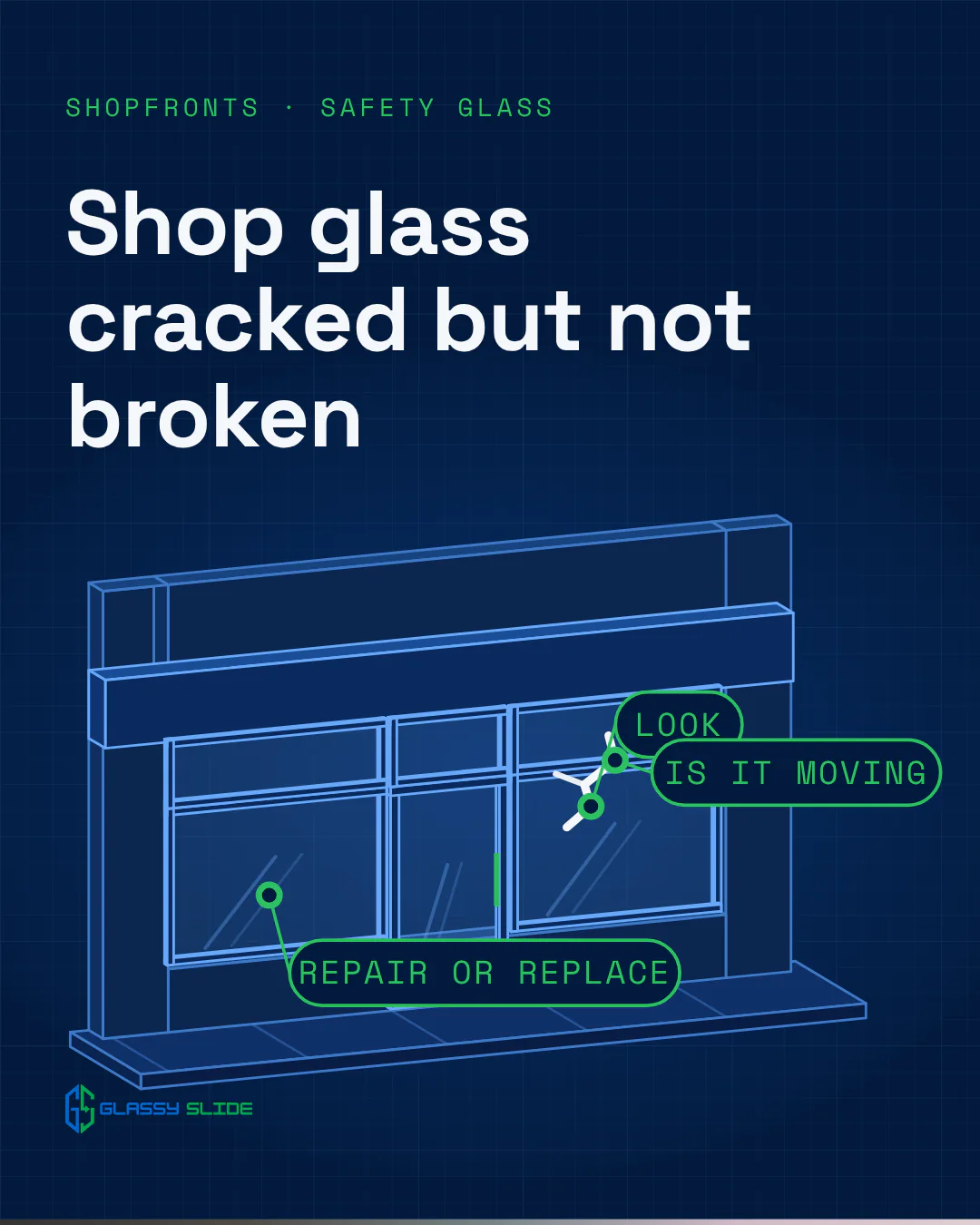
A hairline crack across a shop window does not feel like an emergency. The glass is still in the frame, the shop is still secure and customers can still see in. That is exactly why cracked glass gets left, and why a quiet crack becomes a smashed pane on a windy afternoon.
This guide is about the middle ground between a perfect pane and a broken one: what a crack tells you, how to check whether it is moving, and how to decide between making it safe, reglazing and replacing. If the glass has already fallen out, read the first hour after a smash instead.
This is general information. We can only tell you what a particular pane needs after we have seen it.
What this adds to our other guides
- The first hour after a smash covers glass that has already broken, and what to send us when shop glass breaks at night lists the photos and details for a call-out.
- Who pays for broken shop glass in Victoria covers the lease and insurance question.
- Plate glass insurance for shops covers whether glass cover is worth having.
- This guide covers the earlier moment: the pane is cracked, nothing has fallen, and the question is what to do about it.
Is it urgent? Check from a safe distance
Start with where the crack is, because that decides how fast you need to act. Do all of this by looking, not by touching. Do not press on the glass or tap it to see what happens.
| What you see | How to treat it |
|---|---|
| A crack in a glass door, beside a door, or in glass near the floor where people can fall against it | Urgent. Keep people clear and have it made safe |
| A crack that has grown, branched or reached the edge since you first saw it | Urgent. It is moving |
| A crack with small pieces missing or loose, or glass that looks displaced in the frame | Urgent. Keep people clear |
| A short, stable crack in a high pane away from the door | Soon. Get it assessed and quoted, and keep watching it |
| A chip at the edge or a small star mark | Soon. Chips can grow into cracks |
| A crack in only one layer of a laminated pane, or in one pane of a double glazed unit | Soon. Ask us to look, because the other layer may be hiding the damage |
If you are not sure, treat it as urgent until someone has looked at it.
Why a crack spreads
A crack concentrates stress at its tip. A door slam, a delivery trolley, wind on a large pane, a bump to the frame or a change in temperature can all push the tip further. That is why a crack that has been still for months can move overnight.
Cracks with no impact behind them are common in shopfronts, and often have a cause you can fix. Typical ones are:
- Heat or shade across the pane. Sun on part of a pane while another part stays cold puts the glass under strain, which is why cracks often start at the edge.
- A frame that has moved. If the frame is out of square, or the glass is pressed against metal, it can crack where it touches.
- Edge damage. A chip or nick made during the original fitting or a later knock can grow.
- A small impact that left a chip. The crack arrives days later.
The cause matters, because new glass in the same frame can crack again if the cause is still there. When we assess a cracked pane we look at the frame, the glazing and the edges as well as the crack.
What kind of glass is it?
Shop glass is selected per opening, with AS 1288 as one of the requirements, so different panes in one frontage can be different glass. What the crack looks like tells you something about it.
- Toughened glass normally breaks into small pieces instead of showing a single crack. If a whole pane shows a crack, it is more likely not toughened.
- Laminated glass has two layers of glass bonded to an interlayer. One layer can crack while the interlayer holds the pieces together, so the pane stays in the frame. That is helpful, but it is still damaged. See shopfront security for how laminated and toughened glass compare.
- Annealed (ordinary) glass breaks into sharp pieces and is where a single long crack is most common.
- Double glazed units have two panes with a sealed gap. A crack in one pane can let air and moisture into the gap, so the whole unit usually has to be replaced.
If you do not know which you have, send us photos. We can often tell from the crack and the edge, and we will confirm when we measure.
Repair, reglaze or replace
For shop glass the usual answer is to replace the pane. A crack cannot be taped, filled or glued back to the strength the glass had before, and a cracked pane in a door or low in a frontage is a risk for customers and staff.
| Option | What it means | When it suits |
|---|---|---|
| Make safe | A film, board or temporary glass holds the opening safe and secure while the new glass is made | The crack is urgent, or the new glass will take time to make |
| Reglaze | The pane is removed and new glass is fitted into the existing frame | The frame is sound and the cause of the crack is found |
| Replace the frame or unit | The glass, and the frame or sealed unit around it, are replaced together | The frame has moved, the glazing has failed or the unit is a sealed double glazed one |
New glass is selected for the opening, so the replacement can be a different type of glass from the one that cracked. If the old pane was ordinary glass in a place where safety glass is needed, the replacement may be an upgrade, which changes the price. We tell you what each pane needs when we measure, and the price is in writing before the glass is made. See the shopfront cost guide for what moves the price.
What to do while you wait
- Keep people and stock away. Use a barrier or a sign if the pane is in or beside a door.
- Photograph it from a safe distance. One wide photo of the whole front, one close photo of the crack and one of the frame. Do not lean on the glass.
- Check whether it is moving. Photograph where the crack ends, with the date, and compare the photo each day. Do not mark or touch the glass.
- Do not tape it, glue it or knock out loose glass yourself. Tape can hide a moving crack, and loose pieces should be removed by someone who can do it safely.
- Tell your landlord, agent or owners corporation in writing, and keep the photos with the date. If you need to check who pays, see the who pays guide. If you have a plate glass or business insurance policy, read it and tell your insurer promptly.
If the pane breaks while you are waiting, or you cannot keep people away from it, call us. We make shopfronts safe 24/7 on 0410 107 794.
Cracked glass and the next step
A crack is a good time to look at the rest of the frontage. If the door has been dragging, the cause may be the frame, which also stresses the glass: see a shop glass door that drags or won't lock. If you are thinking of changing the whole front, the guide to comparing shopfront glass quotes gives a table you can use on every quote. If you manage several tenancies, shopfront glass for property managers shows how to record cracks and triage them.
Talk to us
We replace cracked and broken shop glass, supply and fit aluminium-framed and frameless shopfronts and shop doors across Melbourne, and make shopfronts safe 24/7. Send photos of the crack, the pane and the frame on WhatsApp, or use the quote form, and we measure on site and put the price in writing. See safety glass replacement, shopfronts and entry doors or ask for a quote for cracked glass.
Questions
Is a cracked shop window dangerous if it has not fallen out?
It can be. A crack is a weakness, and the pane can fail under a knock, a door slam, wind or a change in temperature. Keep people and stock away from it, especially if it is in or beside a door or low down. If anyone could be hurt, treat it as urgent and have it made safe.
Can a crack in a shop window be repaired?
As a general rule, no. Taping, filling or gluing a crack does not make the pane as strong as it was, so the usual answer for shop glass is to replace the pane. Film or boarding can hold a cracked pane safely for a short time while the new glass is made. We assess each pane and tell you what it needs.
Why does a crack keep getting longer?
The tip of a crack concentrates stress, so a knock, vibration, wind or a temperature change can push it further. A crack that has moved, branched or reached the edge should be treated as urgent. Photographing it from a safe distance each day, with the date, shows whether it is moving without touching the glass.
What causes cracks in shop glass without anything hitting it?
Common causes include heat or shade differences across a pane (thermal stress), a frame that has moved or is pressing on the glass, damage to the glass edge, and a small chip that grew. We look at the frame and the edges as well as the crack, because a new pane in the same frame can crack again if the cause stays.
Is a cracked pane of toughened glass possible?
Toughened glass normally breaks into small pieces rather than showing a single crack, so a whole pane with a visible crack is more likely ordinary glass, one layer of a laminated pane, or one pane of a double glazed unit. Which it is changes the answer, so send us a photo and we will help identify it.
Does a cracked pane of laminated glass need replacing?
A cracked laminated pane can stay in place because the interlayer holds the pieces together, but it has still been damaged and may be weaker. It should be assessed, and replaced where the damage affects the pane's job. Do not assume it is fine because it has not fallen apart.
Who pays for a cracked shop window?
It depends on the lease, what the glass is part of, how it cracked and your insurance, and the Retail Leases Act 2003 may apply. Our guide to who pays for broken shop glass explains how these fit together. Photograph the crack and tell your landlord or agent in writing. This is general information, not legal advice.
What should I send you for a cracked pane?
A wide photo of the whole front, a close photo of the crack taken from a safe distance, a photo of the edge and frame if you can see them, the approximate size of the pane, and whether it is in or beside a door. Send them by WhatsApp or the quote form and we measure on site and put the price in writing.
Was this guide helpful?

We supply and install double-glazed aluminium windows and doors, alfresco enclosures and glass partitions, and repair timber windows across Melbourne from our base in Bundoora. 5.0 ★ on Google.
Keep reading
Related guides
Shopfronts5 min read
Do shopfront windows need double glazing? Heat, noise and the NCC
Does a shop window have to be double glazed? What NCC 2025 says about shopfront glass, when double glazing helps with heat and noise, and what to ask for.

Shopfronts7 min read
Plate glass insurance for shops: is it worth it?
What shop glass cover usually includes, the questions to ask before you buy it, and how to decide if it is worth it for your shopfront in Victoria.
Shopfronts5 min read
Clinic, pharmacy and salon shopfronts: privacy with easy access
Shopfront glass for a clinic, pharmacy or salon in Melbourne: privacy where you need it, clear glass where you don't, and an entry everyone can use.