
Changing the shopfront between tenants: a checklist for owners, agents and tenants
A new tenant often means a changed shopfront. A checklist for owners, agents, tenants: what to record at handover, who approves and what to settle first.
By Glassy Slide teamPublished 5 min read
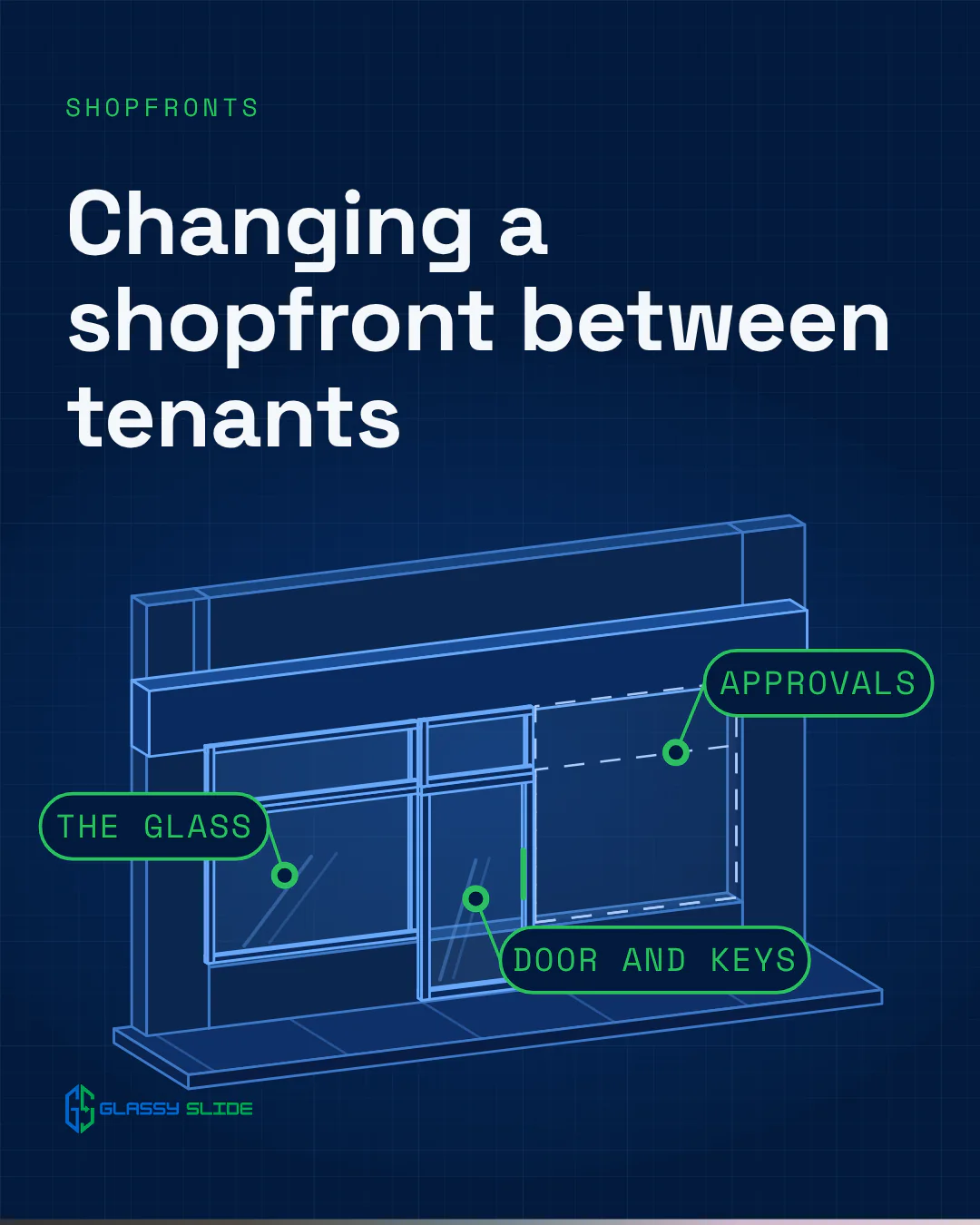
A new tenant often means a changed shopfront: a different door, new signs, frosting for privacy, glass that was cracked years ago. It also means three or four people who each think someone else has already sorted it out. The owner, the agent, the outgoing tenant and the incoming tenant all have a stake in the front, and the problems usually start when nobody wrote down what was there.
This guide is a checklist in the order the questions come up. It does not repeat the permit rules, the cost figures or the broken-glass advice in our other guides. It links to them where they matter.
This is general information, not legal advice. Your lease, the law that applies to it and the registered building surveyor and council for your site are what count.
Before the lease is signed
Settle these while everyone is still talking.
- What is being let. Is the shopfront glass, frame and door part of the building, or something a previous tenant fitted? The answer shapes who looks after it and what happens to it at the end of the lease.
- Whether the Retail Leases Act 2003 applies. It may apply to the premises and can affect repair and glass obligations. Check this early, before anyone assumes what the lease clause means. Our guide to who pays for broken shop glass in Victoria explains why a lease clause does not settle the question on its own.
- What the tenant plans to change. A new door, a wider opening, a sliding or automatic entry, signs, frosting, shutters. Say so in writing so the owner's consent matches the real plan.
- Who has to approve it. Consent from the owner and any shopping centre or building design rules, then the building and planning questions in the shopfront permit guide.
At handover: record what is there
This is the step most often skipped, and one of the least costly to do.
- Photograph every pane, with the date, from a safe place. Include the corners and the bottom edges, where chips show.
- List the cracks, chips, scratches and cloudy or fogged panes. A hairline crack can grow, so note it and who saw it.
- Check the door. Does it close on its own, latch and lock? Does it drag on the floor? Is the closer slamming or the pivot loose? See a shop glass door that drags or won't lock for what each part does.
- Check the markings. Look at whether the glass doors carry markings and whether they are intact; see glass door markings on shop doors.
- Count the keys, note the lock type and record who holds them.
- Look at the entry for access. Step, threshold, door width and weight. The accessible shop entrance guide explains what a new door can bring in.
- Write it down and sign it. One page, dated, with the owner or agent and the tenant each holding a copy.
Do not go near damaged glass to take a closer photo. If a pane is cracked and could fall, make the area safe first.
What to fix and what to change
Once the record is made, sort each item into one of three groups.
- Leave as is. Sound glass, a door that works, a lock that holds.
- Repair. A closer, pivot, patch fitting or lock that has worn, or a single cracked pane in a sound frame. A repair is often the smaller job and the quicker one to organise.
- Change. A frame that is bent or out of square, glass that no longer suits the use, an entry that does not suit the trade, or a front that does not match what the lease allows. Replacing an old shopfront sets out when that is worth considering, and frameless or aluminium-framed shopfronts compares the two systems.
If glass has to change, it is selected for each opening, with AS 1288 as one of the requirements. A pane beside a door or near the floor is a different job from a high window, so an old pane may not simply be copied.
Signs, frosting and security
New tenants often want these before they open.
- Signs and logos on the glass can need the owner's consent and, depending on the site, a planning permit. Ask before you order the signage.
- Frosting or privacy film is a common first change for clinics, salons and offices; see frosting and privacy film on shop glass.
- Security upgrades such as laminated glass, film or grilles are covered in shopfront security. Some need approval, so raise them in the same conversation as the rest.
Who does what: a one-page split
Agree this in writing before the work is booked. Each line is a question, not an answer, because the answer depends on the lease and the law that applies.
| Question | Owner | Agent | Tenant |
|---|---|---|---|
| Consent to the change in writing | |||
| Building and planning enquiries | |||
| Who orders the quote and approves it | |||
| Who pays for it | |||
| Access, keys and working hours | |||
| Footpath and public safety | |||
| Who holds the paperwork afterwards |
Mark one name against each row. If a row has two names or none, that is the item that causes trouble later.
Getting the work done
A few things make the glazing go smoothly.
- Get a measured, written quote that names the glass for every pane and lists removal, making good and hardware. Our guide to comparing shopfront glass quotes gives a table you can fill in, and the shopfront cost guide shows what moves the price.
- Agree the working hours with the owner and agent, and with neighbouring shops if the footpath is shared.
- Plan for the opening to be secure each night. If glass breaks before or during the change, see what to do in the first hour.
- Keep the paperwork: the consent, any permit, the quote and invoice, and the glass details. The next handover will be easier for it.
After the work
Walk the front with the owner or agent. Check the door opens, closes and locks, the glass is clean and undamaged, the markings are in place and the keys match the list. Photograph it, date it and file it with the handover record. That is the starting record for the next change. If you look after many tenancies, our guide for property and strata managers shows how to keep one record per frontage.
Talk to us early
We supply and fit aluminium-framed and frameless shopfronts, shop doors and shop glass across Melbourne, and we repair closers, pivots, patch fittings and locks. We measure first and put the price in writing, with the glass named for every pane. Tell us if the shop is changing hands and what needs approval, and we will quote to suit. See shopfronts and entry doors or ask for a shopfront quote and send photos of the frontage and the door.
Questions
Who decides whether the shopfront can be changed when a new tenant moves in?
Usually several people. The owner or landlord, and often the managing agent, give consent under the lease. The registered building surveyor decides whether a building permit is needed, and your council decides on planning, heritage and signs. Ask in that order before you order anything.
What should be recorded about the shopfront at handover?
The condition of every pane, the frame, the door, the closer and lock, the glass markings, the number of keys and any damage already there. Dated photos from a safe distance, a short written list, and both sides' sign-off make later disagreements much easier to settle.
Who pays to change or fix the shopfront?
It depends on the law that applies, the lease and the circumstances. The Retail Leases Act 2003 may apply and can override lease terms, so check it first. If the position is disputed, ask the Victorian Small Business Commission or a qualified Victorian leasing adviser. This guide is general information, not legal advice.
Can a new tenant keep the old glass and door?
Often, if they are sound. Look at cracks, chips, a door that drags, a closer that slams, a lock that sticks and glass that may not suit the opening. A repair is sometimes enough. If the glass or door has to change, it is selected for the opening, with AS 1288 as one requirement.
Do new signs or frosting on the glass need approval?
Often, yes. The lease may need consent, and your council may need a planning permit for signs, especially in a Heritage Overlay. Check before you order, and see the permit guide for how the rules fit together.
Can the shop keep trading while the front is changed?
Sometimes, if the work is planned around trading hours and the opening is made safe each day. Agree it with the owner and agent before the work is booked, and ask the glazier how the opening will be secured between visits.
How do I ask for a shopfront quote from you?
Send photos of the frontage and the door on WhatsApp or use the quote form. We measure on site and give the price in writing, with the glass named for every pane.
Was this guide helpful?

We supply and install double-glazed aluminium windows and doors, alfresco enclosures and glass partitions, and repair timber windows across Melbourne from our base in Bundoora. 5.0 ★ on Google.
Keep reading
Related guides

Shopfronts5 min read
Do shopfront windows need double glazing? Heat, noise and the NCC
Does a shop window have to be double glazed? What NCC 2025 says about shopfront glass, when double glazing helps with heat and noise, and what to ask for.

Shopfronts7 min read
Plate glass insurance for shops: is it worth it?
What shop glass cover usually includes, the questions to ask before you buy it, and how to decide if it is worth it for your shopfront in Victoria.

Shopfronts5 min read
Clinic, pharmacy and salon shopfronts: privacy with easy access
Shopfront glass for a clinic, pharmacy or salon in Melbourne: privacy where you need it, clear glass where you don't, and an entry everyone can use.